• Skip to main content
  • Skip to footer

USGG 100-Ton Master Captain Jeff Vegas

White Glove Captain Services

  • Home
  • Services
  • Passion
  • Testimonials
  • Commissary
  • Captain’s Blog
  • FAQs
  • Drop a Line

ClassyCaptain

Mar 31 2023

40 Conversation Starters for Any Voyage, Short or Long.

I love sailing with people that I have just met, and, of course, I want them to have a great experience and I, selfishly, also want to have a great experience.

Sometimes there are lulls in the conversation, and if you want to get a nice small group to chat, here are (I think) some great questions to ask… starting with the one I ask almost everyone who boards a boat with me:
What is your favorite boat name, and why? (for clarity, this is not necessarily the name of a boat you own) Boat names seem to have some important meaning to their owners and almost always have a nautical theme, so I ask my passengers to come up with the name that they want to bestow on a boat… it tells me something about their personality. I also always give them one boat name I really like. For example, I spent many years as a real estate agent, and when I set out with 2 of my real estate agent friends to buy a boat, we discussed calling it Reeltor (Realtor, but like a fishing reel)

Here are a few others:

  • Tell me about your best day on the water.
  • If you could have a superhero or cartoon caracter for a best friend, who would it be?
  • If you could have any real animal as a pet (so not a unicorn or bigfoot), which would you choose and why?
  • Where is one place you’d love to travel to again?
  • What’s your favorite comfort food?
  • What was the best meal you ever enjoyed?
  • What do you love most about your home?
  • What gives you goosebumps?
  • Tell me about your childhood best friend.

  • What’s one habit you want to improve on, one habit you want to get rid of, and one habit you want to keep “as-is”?
  • If you were to sing a duet with a famous singer, living or dead, who would it be and why?
  • Who do you most admire, living or dead?
  • What was the first big ticket item you pruchased as an adult?
  • Have you kept any meaningful memorabilia from when you were a kid?
  • What instrument that you don’t play, do you most wish you did?
  • If you could travel back in time, specifically to your life, when would you go back to and why?
  • What is the compliment you hear most often?
  • What’s your earliest memory?
  • What are some of your best memories about your parents or whoever raised you?
  • What is something you have accomplished so far that your younger self would be very proud of?
  • What did you like most about school? (and don’t say nothing… even if you did not like school much, there was something you liked)
  • What superpower do you wish you had?

  • What superpower do you have? (your best real trait, like negotiating or ??)
  • What accomplishments are you most proud of?
  • What is the best thing about your house?
  • What do you want to be when you grow up?
  • If you could live in any other country for 1 year (money is no object), where would you go?
  • What’s one of your favorite memories from your childhood?
  • What was your favorite subject in school? Which characteristics are you happy that you inherited from your parents?
  • What food reminds you most of home?
  • What about the state of our current planet would be most surprising to your younger self?
  • What was your very first job?
  • What’s one act of kindness you experienced today?
  • What do you do for enjoyment?
  • Do you prefer being around other people or spending time alone?
  • If you had a whole day to yourself, what would it look like, what would you do, and where would you go?
  • Who do people tell you you look like?
  • Do you collect anything?
  • What’s one thing your loved ones would be surprised to learn about you?

If that does not spark some interesting conversations, please find people who are alive LOL.

Image by rawpixel.com

Fair Winds
Captain Jeff Vegas

Written by ClassyCaptain · Categorized: Tips and Tricks

Mar 24 2023

Pre-Departure Checks Can Keep a Bad Day from Getting Worse.

A few years ago, a friend of mine backed out of the dock only to learn that his steering linkage had broken, and he no longer had control over the vessel… what now?

And just a few weeks ago my friend Mark shared with me via email “I did the normal pre-departure checks prior to sailing Thursday & Friday and found no problems. Then on Saturday, I found the bilge below the motor full of water when I looked into the engine compartment prior to leaving the slip. I found this to be saltwater, so I shut the raw water sea cock and searched for the leak. It turned out to be at the impeller housing, or at the end of the hose that connects to the impeller housing. It is under the alternator and super hard to access so I can’t tell for sure where the water is coming from, but there was a stream of water shooting out that slowly filled the bilge below the motor with sea water over the course of a day or so. I borrowed a hand pump from a guy a few slips down to remove the water so the engine wasn’t sitting in salt water.

As I mentioned, there were no problems found during my checks before sailing Thursday or Friday, but there was on Saturday.”

This means it’s really important to do all the pre-departure checks every day before you shove off.

Look, you can’t prevent every issue, but these things happen and wouldn’t you rather find out before you untie if possible? Every vessel is different so every one will have its own version of the list. Here are a couple that I recommend that I don’t think a lot of private skippers do. And I suggest you do these every time:

  • When you start your engine, check over the side of your vessel to make sure the engine is expelling water. Water is what cools your engine, and if water is not coming through for some reason, the time to find out is now.
  • Then, just before you untie, put your vessel in gear; forward for 30 seconds and then reverse for 30 seconds. In forward gear, look over the stern of your vessel and you should see the water a little disturbed. When in reverse gear, look over the side.
  • Finally, turn your rudder all the way left and all the way right. If you have an autopilot, it probably has an instrument in it that tells you where your rudder is in relation to center. Watch that dial as you turn the wheel. If everything looks good and feels normal, then you can shove off (if the linkage is broken, the wheel will spin too easily).

Fortunately for my friend who lost steering, there were a few boaters on the docks willing to help out. He threw them some lines and they wrangled the boat back into the slip. But an extra 2 minutes spent running a couple of prelaunch checks would have been an even better solution.

If you need a pre-departure checklist, drop me a line and I’ll send you mine… it will likely need some adjusting based on how your vessel is different than mine, but it will help you get started, and I assure you there are way more than these 3 items on it.
Fair Winds
Captain Jeff Vegas

Written by ClassyCaptain · Categorized: Captain's bLog, Safety

Mar 17 2023

Boat BBQs – Worth the Risk?

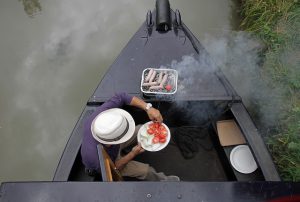
When on land, the BBQ is my favorite cooking apparatus, so on board the boat, it’s only natural I want to use one too. Whether catching fish or just grilling the kabobs we brought with us, BBQ’s and the outdoors just go together in my opinion.

Image by Karolina Grabowska from Pixabay

However, just because your boat is surrounded by water does not make it fireproof. Each year, boat BBQs cause fires that damage and sometimes destroy boats, which means, like so many other things related to boats, BBQs need to be treated with respect. Most BBQ fires occur because someone didn’t make good decisions. Now I am not a fan of using charcoal grills on a boat, personally, but if you are going to, consider only using charcoal that does not need lighter fluid. If you do use lighter fluid, only use fluid specifically made for the charcoal grill. Never use gasoline or alcohol. They are extremely dangerous.

The BBQ should always be clear of the boat when in use, which usually means hanging over the gunwale (unlike in the photo below) so any hot ashes or drips go into the water. Make sure the wind is blowing away from the boat, so any breeze does not blow these things onto the deck anyway. In fact if there is more than a light breeze, you probably shouldn’t even start the grill.

Image by Monica Volpin from Pixabay

Which is another reason for using propane over charcoal. If conditions become unsafe after starting the propane grill, it’s much easier to extinguish the flames. Also note that many marina’s prohibit BBQ’s on the docks, so make sure you check with yours to understand the rules. Finally, always keep the documentation and follow the manufacturers safety recommendations. No matter how tasty those BBQed wings will be, it’s not worth catching your boat on fire.

Fair Winds
Captain Jeff Vegas

Written by ClassyCaptain · Categorized: Tips and Tricks

Mar 10 2023

Boating at Night Can Be Beautiful… When Done Safely.

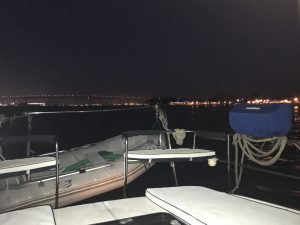
The San Diego skyline at night is particularly calming when viewed from a boat (as is most everything in my humble opinion). There is nothing like floating in the Harbor at around 9 PM on a July evening and sharing some nosh and a bit of laughter with friends. The tricky part can be navigating back to the dock or ramp. There’s the issue of other boats that may not be lit properly (or at all), debris and obstacles in the water, and the obviously limited visibility. In some waters, you may not have the aid of all the lights the San Diego Harbor provides.

Photo by Lucas Davies on Unsplash
Photo by Lucas Davies on Unsplash

Whether you’re enjoying a romantic sunset sail, heading home after a dock-and-dine at your favorite waterfront restaurant, or you’ve simply let time fly while having fun, and didn’t notice how late it was getting, sometimes you’ll operate your boat after dark. Of course, the best protection is to ensure that you are prepared before ever shoving off. Here are a few tips for staying safe while boating at night.

Although you should do these 2 always, I feel they are worth reiterating for travel at night;
Check tide and weather reports before shoving off.
Keep flotation devices in an easily accessible place.

  • Helpful Tips for Boating at Night
    Make sure your own navigation (running) lights are in working order and on. Running lights (or a handheld torch for smaller craft) are required in all navigable waters between sunset and sunrise so you’re visible to other vessels.
  • Make sure that your engines are in proper working order and that your electronics – such as chartplotters, GPS and VHF radios – are on board the boat and are charged or have full battery life. Do the same for flashlights and headlamps. A red filter on flashlights can be helpful for nighttime viewing. Your eyes will stay adjusted to the dark while still be able to see things more clearly.
  • Get a responsible extra pair of eyes to assist you as lookout (watching the horizon for oncoming boats and obstacles).
    Be alert and listen for the sounds of other boats and fog horns as well as land-based sounds. I love music as much as the next person, this just isn’t the time for that.
  • Go slower than you would with full daylight. If you were racing, you’re not anymore. Darkness sometimes changes your depth perception. With reduced visibility, it’s more difficult to gauge distances and obstacles along the way. Use extra caution and go as slow as you can go, while still maintaining steerage when landing or docking the boat.

  • Be alert and on the lookout for any lights. They may be on another vessel, or some kind of marker. Make sure you are familiar with what the lights mean. It’s not red for stop and green for go.
  • Dim onboard lights like courtesy and instrument lights. This will help with your night vision. Just remember to make the instruments bright again when you are at your destination, or you may not easily be able to in the daylight.
  • Make sure you have plenty of fuel, even in a sailboat, as winds often die down after dusk.
  • Have a spotlight on board – even if it is just a handheld. Don’t use it like a headlight though as light reflects off the water.
  • Flashlights can be helpful when you land at the dock or ramp for finding cleats, pilings, line and handrails (as well as for ease in stepping off the boat).
  • Attach strobe lights or glow sticks to to your PFDs just in case.

Night boating can be beautiful, and the tips above should help ensure it ends beautifully as well.

Fair Winds
Captain Jeff Vegas

Written by ClassyCaptain · Categorized: Captain's bLog, Safety

Mar 03 2023

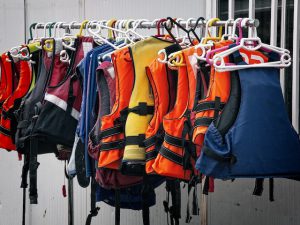
Life Jackets: Wear vs Have Handy?

I remember when I was in the Boy Scouts, we were not allowed to call them “lifejackets”, because that implied it would save your life. We were taught to call them PFD’s (Personal Flotation Devices) because their job was to help you float, which may or may not be enough to save your life. That was an important distinction that helped us be prepared for other water issues, like hypothermia or head trauma. So in this article, I’m going to take literary license and call lifejackets, PFD’s

California law (and I think basic decency) requires that every child younger than 13 must wear a PFD at all times while on a moving vessel less than 26′ in California. Some states have a different requirement. On my boat it has always been 14. I don’t have any proof for the distinction, I have just always felt it should be 14, so on my boat that’s my rule. (as long as my rules are not less stringent than the law, I have that right)  The PFD should of course be of the appropriate size for that child. In my opinion, if you have a kid under about 5 who likes to climb and run and, well, be a kid, it’s not the worst idea to tether the PFD with a line as well, so if they do go in, it is easier to get them out. But what about the rest of you on board?


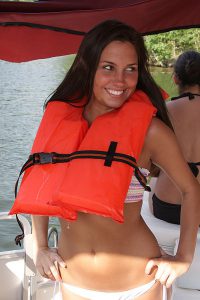
To meet U.S. Coast Guard requirements, a recreational vessel must have a U.S. Coast Guard Approved PFD for each person aboard, and that means one that would fit each person. If you have 3 adults and 2 children, 5 child sized PFD’s (nor 5 adult sized PFD’s) would suit each person aboard. And they must be easily accessible (not in a closed and latched compartment). So you and your loved ones are in a boat and the PFD’s have to be accessible, which means they might be on a seat, where they are potentially in the way of sitting and relaxing or even subject to blowing out of the vessel with a nice breeze… hmmm… how to solve that issue. Well if you put it on, it won’t be in the way or blow out, of course it won’t help your tan line either, so there are 2 reasons to put it on and one not to. Oh, and are you one of those boaters who does not even keep them handy? Well the local governing body of your waterway can (and I have seen them do it) issue steep fines, so I suggest you at least do that.


originally posted to Flickr as Goofy Orange Life Jacket Model

Many responsible boating organizations will say ‘always’ wear your PFD, and I say ‘always’? And they say, OK smarty pants, ‘always when boating’ so I say ‘always when boating?’ and they say ‘YES!’ And I say, ‘always when I am boating and anchored and below deck?’ and they say, ‘well, ok, maybe not’ and then I say ‘what about when I’m boating on a cruise ship? Or the San Francisco Bay Ferry?’

So I was reading this one blog and the writer says he recommends ‘Whenever on the water on a vessel of any kind, alone’ and I cringed… please don’t boat alone. We all think nothing bad will ever happen to us, but bad things happen, so I implore you to never boat alone. Some of you are thinking ‘but what about a one-person kayak, you do that alone’ and I would respond, ‘not if there are 2 of you, each in a one person kayak… now you’re not alone and if something goes wrong there is someone to potentially help you or call for help, or at least tell the authorities what happened.’

OK, I’m off my soapbox for now, but you may want to read about the one time I went ‘alone’

Look, if you’re over 18, you’re gonna do whatever you want, however, in my opinion, you should strongly consider wearing a PFD when recreational boating, even if it will hurt your tan line, under the following circumstances.
If you are not a strong enough swimmer to swim for 30 minutes without touching a floor of some kind (the bottom of a pool or rocks or sand)
If the water temperature is below 70 degrees
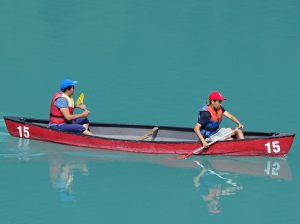
If the boat is not very stable (like a kayak or canoe)
IF the weather could be considered ‘foul’
Here is something you should know before I go farther: According to the U.S. Coast Guard, half of all recreational boating fatalities happen in calm water. And all are unexpected.

And finally, in any other situation where someone has a ‘bad feeling’ you should strongly consider wearing a PFD when recreational boating. Human’s have amazing intuition, and often the first indication of actual danger is someone’s ‘bad feeling’. Those should not be ignored. I just hope they speak up when they have that feeling.

To wrap it up, PFD’s do help save lives and I hope you never need yours.
Fair Winds
Captain Jeff Vegas
Watch video testimonials for Captain Jeff Vegas by clicking this link

Written by ClassyCaptain · Categorized: Captain's bLog, Safety

  • « Go to Previous Page
  • Go to page 1
  • Go to page 2
  • Go to page 3
  • Go to page 4
  • Go to page 5
  • Go to page 6
  • Go to page 7
  • Go to Next Page »

Footer


LogoTerms of Use  |  Privacy Policy


Copyright © 2026 ·Top Hat and Sails